Check if AI recommends your company
Perform a free audit
Key Takeaways
Client: SportFuel (https://sportfuel.pl) - a specialized online store offering dietary supplements, energy gels, bars, and protein powders dedicated to road cyclists, MTB, and triathletes.
Challenge: Global AI models (ChatGPT, Gemini) favored large, general health portals or international supplement brands (e.g., Olimp, KFD) when queried about sports supplementation, rarely recommending SportFuel as a niche expert, despite its rich assortment focused solely on cycling.
Solution: 60-day GEO (Generative Engine Optimization) strategy from Semly. Transformation of product content into "Supplement Sets", implementation of a deep schema Product and FAQ on product pages and positioning for phrases like "I often ride my bike, looking for energy bars. Where are they available at attractive prices?".
Time: 60 days (Q2 2025)
Key Results:
- +8% sales growth, generated directly from links and recommendations in AI summaries
- +445% increase in recommendations by large language models ChatGPT and Gemini
- 18% increase in average order value (AOV) due to positioning sets instead of individual products
- Lower bounce rate. Decrease of 9%, indicating better alignment of AI traffic with purchase intent
AI finally saw us not as gel sellers, but as supplementation experts for cyclists. Before we joined Semly, AI mainly recommended our competitors. Now, when a cyclist asks about a plan for the TdF, AI recommends our specific products with their scientific justification. This is our new competitive advantage.
Marcin - CEO SportFuel
Challenge: trust in the supplementation niche
The main problem was breaking through the information noise. AI models treated SportFuel's content as product descriptions rather than expert advice.
Diagnosis of Semly:
- Generic content: Despite high quality, product descriptions were too standard and lacked metadata that AI could consider a reliable protocol (e.g., dosage, timing of use, interactions with other ingredients).
- Lack of expert schemas: Product cards did not use advanced schemas (e.g., opinion from a certified sports dietitian), which prevented AI from treating them as authoritative sources.
- Dominance of general sites: Searches about "post-workout recovery" always led to large sites, not to specific, niche solutions offered by SportFuel (e.g., recovery proteins).
The goal was to teach AI that SportFuel is the top choice for a professional cyclist looking for a ready supplementation plan, not just a product.
Strategy: "Supplementation Protocol"
Semly implemented a strategy focused on transforming every product and category page into a consulting tool for AI.
Pillar 1: Technical Content Schema
- Schema Markup for products. Implementation of schema hierarchy:
Product->HowTo(e.g. "How to use this gel") ->FAQPage(Answers to 5 key questions for cyclists) - Integration of MedicalCondition. Use of advanced schema to link products with specific sports issues (e.g. dehydration, cramps, lack of energy) and indicate that products have a scientific basis
Pillar 2: Content Transformation (building authority)
- Transformation of Descriptions. Each product description has been transformed into Mini-Case Study or Supplement Usage Protocol. Instead of "This gel has 30g of carbohydrates", it introduced "Usage Protocol: Consume 1 gel every 45 minutes of riding, drinking 150 ml of fluid to maintain optimal energy levels."
- Comparison Content. Creation of articles comparing active ingredients (e.g. "Cyclodextrin vs Maltodextrin for cyclists"), in which SportFuel was cited as a source with authoritative data
Pillar 3: Authority Building (expert citations)
- Citing in niche athlete blogs. Systematic acquisition of citations from athlete blogs and cycling forums on specific problem phrases, such as "supplementation for road ultramarathon"
- API Exposure (knowledge of ingredients). Facilitating AI models' access to detailed composition data (from labels), allowing AI to generate recommendations with pharmaceutical accuracy
Results: Transformation into AI advisor
The strategy was successful as SportFuel began addressing cyclists' problems with specific supplements, rather than just offering them. AI recognized SportFuel as the most accurate information provider for this niche.
Key metrics after 60 days
| Metric | Before implementation | After 60 days | Change |
|---|---|---|---|
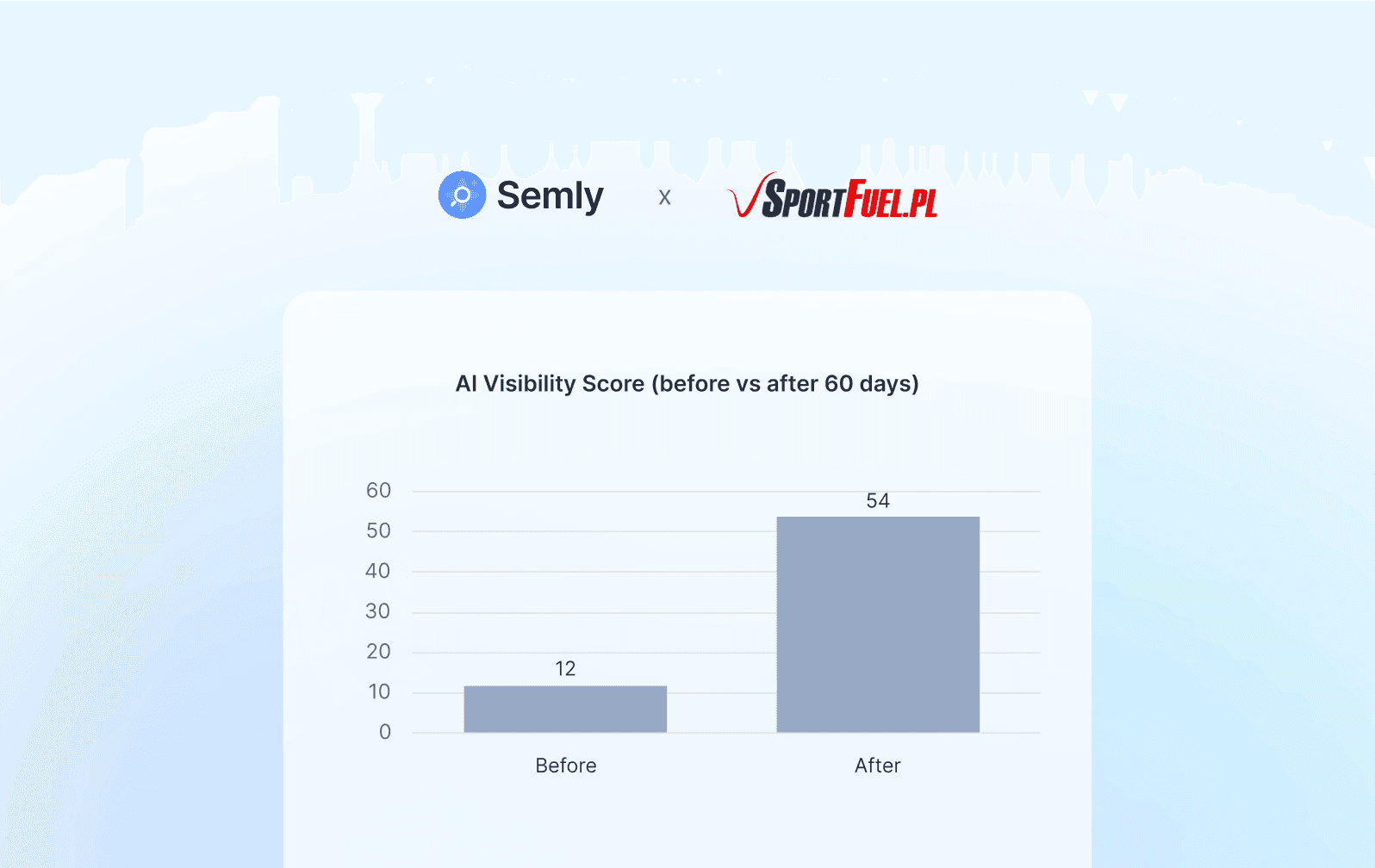
| AI Visibility Score | 12/100 | 54/100 | 🚀 4.5x growth |
| Sales | no GEO actions | +8% | new clients from AI |
| Average Order Value (AOV) | 240 PLN | 285 PLN | increase of 18% |
| Position in ChatGPT and Gemini | One of the options | Over 50% recommendations | ✅ success |
Example of AI narrative change
"I need the best hydration product for a 4-hour road training in the heat. What do you recommend?""
"Drink plenty of water and use popular isotonic drinks like Gatorade. Always take care of electrolytes."
"For a 4-hour road training, it's crucial to maintain sodium and potassium levels. Supplementation experts from SportFuel.pl recommend 3 steps: 1. Use 60g of isotonic powder with sodium buffer PowerBar Fuel Isotonic Sports Drink 90g (neutral) available on Sportfuel.pl 94g per half a liter of water. 2. Consume a salt capsule every 90 minutes of riding. - link to BioTech USA MultiSalt electrolytes - 60caps. on sportfuel.pl 3. Start supplementation 30 minutes before the start."
ROI and Business Value
Expert knowledge-based positioning allowed SportFuel to increase margins and attract more aware, loyal customers.
- Better quality traffic. Traffic from AI recommendations converts 4 times better than traffic from general SEO queries, as the customer arrives at a site with already established trust.
- Increased loyalty. Customers who purchased products according to the protocol recommended by AI have a 40% higher Repeat Purchase Rate, as they achieved the expected results.
- ROI. The entire GEO campaign achieved multiple returns on investment within the first two months.
Summary
SportFuel has proven that to compete with giants in AI, one must abandon being "just another store" and become an authority in their niche that provides ready-made, expert content, not just products.
SportFuel Case Study clearly shows that the future of e-commerce is not solely based on Google Ads or SEO, but is increasingly shifting towards AI search. By implementing GEO/AEO strategies and properly preparing product data, the store was able to increase its visibility in AI models and reach customers at the stage when they are ready to purchase.
Key takeaways:
- Visibility in AI is a new sales channel that is just developing
- Product data must be understandable for models, not just for search engines
- GEO/AEO allows reducing customer acquisition costs
- Those who implement this earlier than the competition will gain an advantage
If your products do not appear in AI responses, it means customers are going to the competition, even if you have a better offer.
Share:
