

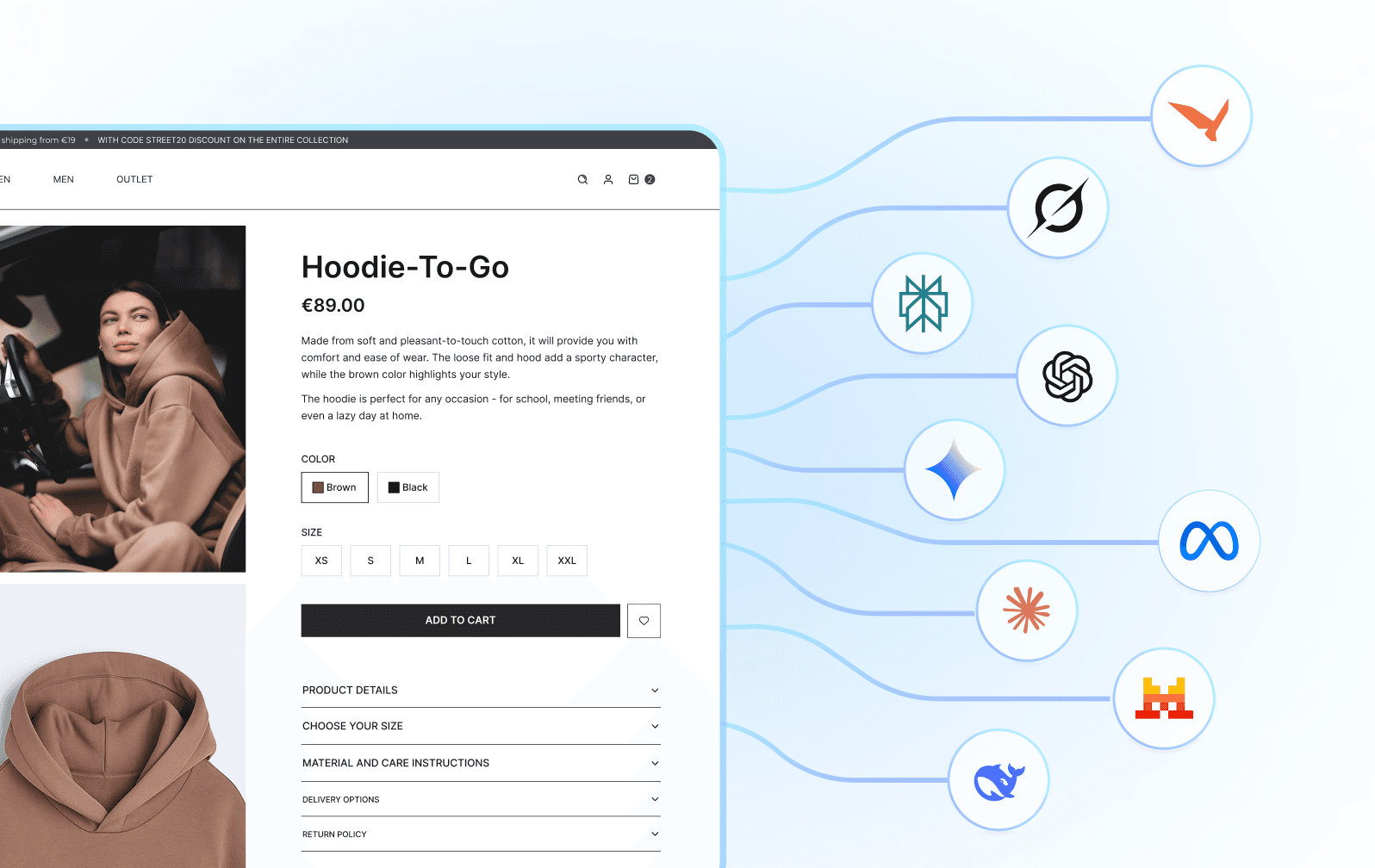
Add your store to AI
Let yourself be found
What you need to have on hand
The most important is aktual product feed in Google format (XML) with basic attributes: iD, title, description, website link, photo link, price, availability, brand and if it exists - GTIN. It's good if your delivery, returns and warranty policies have separate, readable URLs. Also consider whether you want to allow AI bots (e.g., GPTBot) into the site - this will be set in the robots.txt.
Integration in five minutes
Start by checking that the feed URL opens publicly and returns a code of 200. Then register the store in a no-code tool of your choice, e.g. Semly. The form usually asks for name, domain, country, currency and language - and to paste in the feed address. After a quick import, you'll see the attribute mapping. Here it's worth spending a minute on the details: whether "brand" goes into the right field, whether the GTIN is visible, and whether products without identifiers have "identifier_exists=no".
The next moment is the terms of purchase. Models like specifics, so enter them in full sentences: delivery time (e.g. 24-48 h), free shipping threshold, length of return period, return label and warranty information. After saving your settings, click "publish" or "enable sync" - and you're done. From now on, the feed is regularly downloaded, and your content becomes easier to cite in AI responses.
How to write so AI will want to quote
"Answer-first" paragraphs work well: first a clear answer with a number, then a brief expansion. On product sheets, add a question and answer section, but write them in natural language, such as. "Can I return the product? Yes, within 30 days. A return label is included in the package." Give technical parameters in uniform units and in a fixed order (capacity, dimensions, material, compatibility). Models also better understand content with an update date and clear authorship, so add "Update: [date]" at the end of pages.
How to know that it works
The easiest way - by asking queries in Perplexity and seeing if your domain appears in the footnotes. Test several variants of queries: in Polish and in English, with the attribute "to [use]", with the delivery condition "in 24 h", with the annotation "in Poland" or "in the EU". Record which parts of your pages the system quotes most often. On the store side, monitor conversion and cart value from sessions that come from such tests (a simple UTM in the link will suffice).
The most common stumbling blocks and quick fixes
If the feed doesn't load in the tool, check that it's not behind a login and that the server isn't blocking the download. When visibility in AI responses is poor, the deficiency usually lies in IDs (GTIN/brand) or in overly general content. Add specifics: delivery times, return terms, free shipping thresholds, and a short paragraph in category descriptions "for whom it is" and a mini-comparison of variants. If you do not want AI to use your content - block the relevant bots in the robots.txt. If you want - make sure you don't block them.
FAQ
Do I need to have a GTIN?
If the product has it, it's worth it - it makes it easier to match the quote and increases the chance of a correct quote.
Does this change anything in SEO?
Yes, but more in the direction of AEO/GEO: the content should be understandable to people and to models, and success is not only the position, but to appear as a credible source in the answer.
How much technology is involved?
Minimum. A well-described feed and a few clear paragraphs on the page do most of the work.
Summary
Integration without code is, in practice, a few fields to fill in and a single feed address. The real advantage, however, comes in the quality of the data and content: consistent identifiers, specific purchase rules and "answer-first" language. With this set-up, your store has a much better chance of being pointed - and quoted - by AI systems exactly when a customer makes a purchase decision.
Share:
