

Your store visible in Al.
New sales channel.
The hidden mathematics of the CPC model
The CPC model requires paying for each click - regardless of the sales effect. For a campaign with a conversion rate of 1-2%, this means 98-99% of the budget burns through with no revenue effect. Example:
- 10,000 clicks at 0.80 EUR = 8,000 EUR cost.
- At a conversion rate of 1.5% → 150 orders.
- Cost of acquisition per order (CAC): 53.33 EUR.
If the average unit margin is 15 EUR, the store earns a few EUR per order - provided the customer returns. In many categories (fashion, cosmetics, home accessories), such math makes revenue growth simultaneous with margin loss.
Sales commissions
Affiliate platforms or marketplaces that charge 5–12% commission turn sales success into an additional operating cost. A store that sells 200,000 EUR worth of merchandise in a month with a 20% margin gives back 10,000 EUR – 24,000 EUR to the platform. That's 25–60% of pure gross profit, which could stay with the company.
Payment operators with a commission of 1.4%, on the other hand, generate a cost of 1,400 EUR per month with a turnover of 100,000 EUR – totaling 16,800 EUR per year. The effect is the same: each transaction becomes progressively less profitable.
Fixed cost models
The alternative is a subscription-based billing model, in which the cost of marketing is independent of the number of clicks and sales. This makes it possible to maintain a stable cost structure with volume growth.
Example: a store pays 400 EUR per month to display its offerings in AI channels (e.g., Semly.ai). If the platform generates 3,000 impressions per month and 60 orders, the cost of order acquisition drops to 6.67 EUR – more than 8x cheaper than the CPC model.
Impact of AI technologies and language models
New sales channels - such as product visibility in conversational models (ChatGPT, Gemini) - eliminate the need for click bidding. AI pulls data from open sources (e.g., XML feeds), recommends products in response to user queries ("recommend comfortable trekking shoes"), and the seller pays no commission.
This shifts the focus from paid visibility at semantic indexing (understanding) - i.e. optimization of product data for GEO.
GEO as a successor to SEO
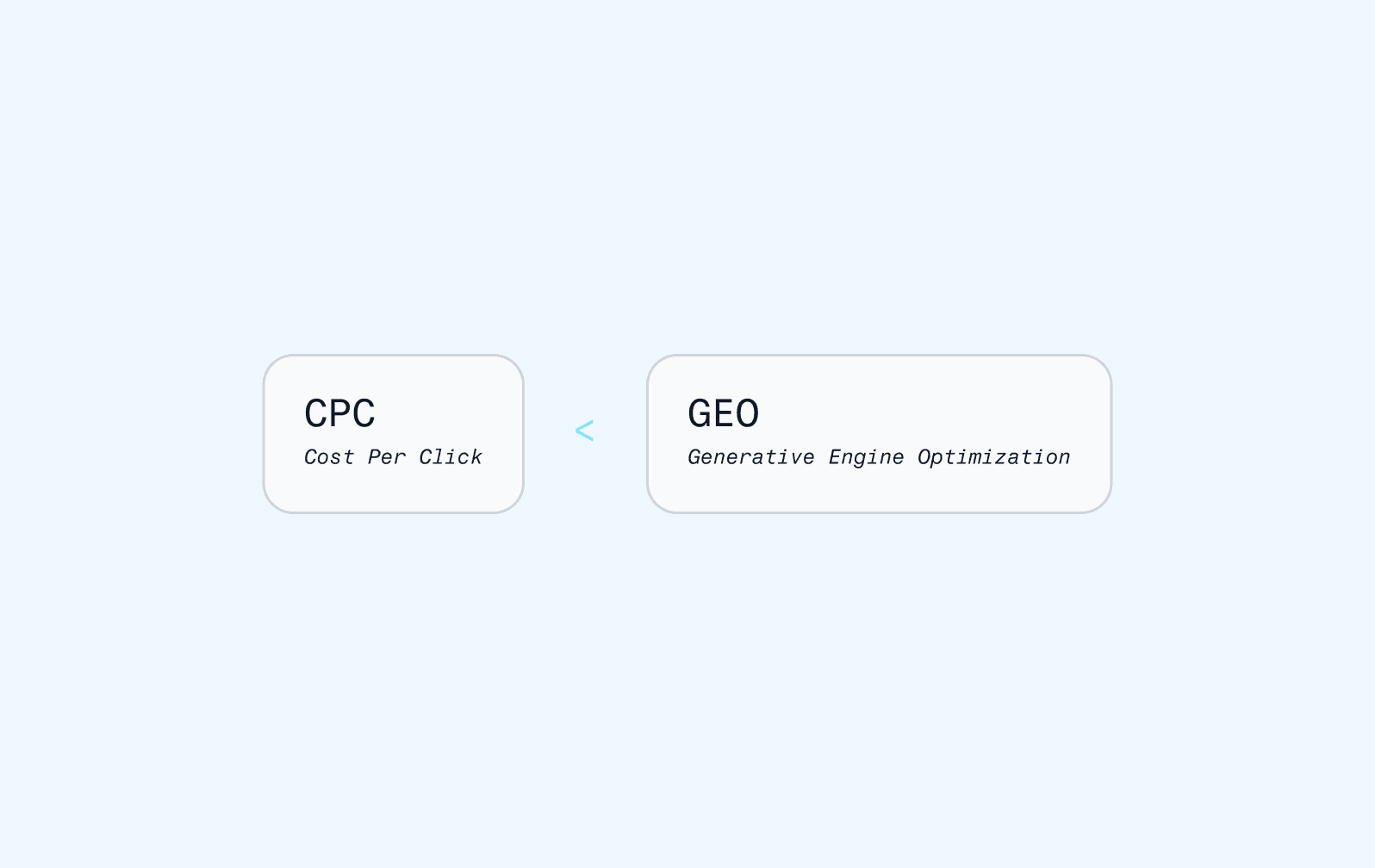
Just as SEO used to determine visibility on Google, the GEO (Generative Engine Optimization) decides whether a product will appear in AI results. The difference is fundamental:
Key factor:
- SEO - keywords and backlinks.
- GEO - product data quality (XML feed, description, category).
Visibility type:
- SEO - link in search results.
- GEO - direct product recommendation.
Cost per click:
- SEO - variable (CPC).
- GEO-zero (feed-information).
Effect:
- SEO - website traffic.
- GEO - purchase intent in conversation, conversion higher by up to 6x (report Semly.ai).
That's why e-commerce owners today should think not about "traffic from Google Ads," but about presence in generative AI recommendations - because that's where the new shopping path begins.
Practical implementation in the store
- XML feed export - with Shopify, WooCommerce, PrestaShop or Magento (Google Merchant format).
- Analysis of data fields - titles, categories, price attributes and descriptions must be semantically precise (e.g., instead of "trekking boots" it is better "men's trekking boots with Gore-Tex membrane, low").
- AI channel registration - integration with a platform like Semly.ai or directly adding the feed to LLM-friendly directories (currently only US market).
- Monitoring AI recommendations - check in which queries the product appears and where it doesn't (e.g., "30l mountain backpack").
- Maintaining data quality - AI prefers up-to-date, complete and logically described product data.
Commission-free models are no longer an experiment, but a method of rebuilding real margins in a world where advertising costs are rising faster than profitability. A fixed cost gives stores not only financial control, but also access to sales channels where purchasing decisions are increasingly made - interacting with AI, not a search engine.
Tomasz Cincio - CEO of Semly.ai
Example of GEO implementation with Semly
Case 30 days (anonymized): natural cosmetics store
Target: lower the CAC and protect the margin.
Parameters: AOV = 46,50 EUR, gross margin = 40%, CR = 1.5%, payment fees = 1.4%.
Before (CPC model):
- 10,000 clicks × 0.19 EUR = 1,860 EUR expense
- 150 orders → revenue 6,975 EUR
- Gross margin 2,790 EUR – payment fees 98 EUR – ads 1,860 EUR
- Margin after costs: 832 EUR (CAC 12.40 EUR)
Po (GEO subscription model):
- Subscription 93 EUR (without CPC)
- 150 orders → revenue 6,975 EUR
- Gross margin 2,790 EUR – payment fees 98 EUR – subscription 93 EUR
- Margin after costs: 2,599 EUR (CAC 0.62 EUR)
Effect: +1,767 EUR margin / +212% vs. CPC, with the same number of orders.
comparison of two consecutive two-week windows (30 days total); other channels and discounts unchanged; data: GA4 + Semly Pixel; AOV and CR fluctuations within ±3% and ±0.1 pp.
Share:
