

Add your products to AI
Gain a new sales channel.
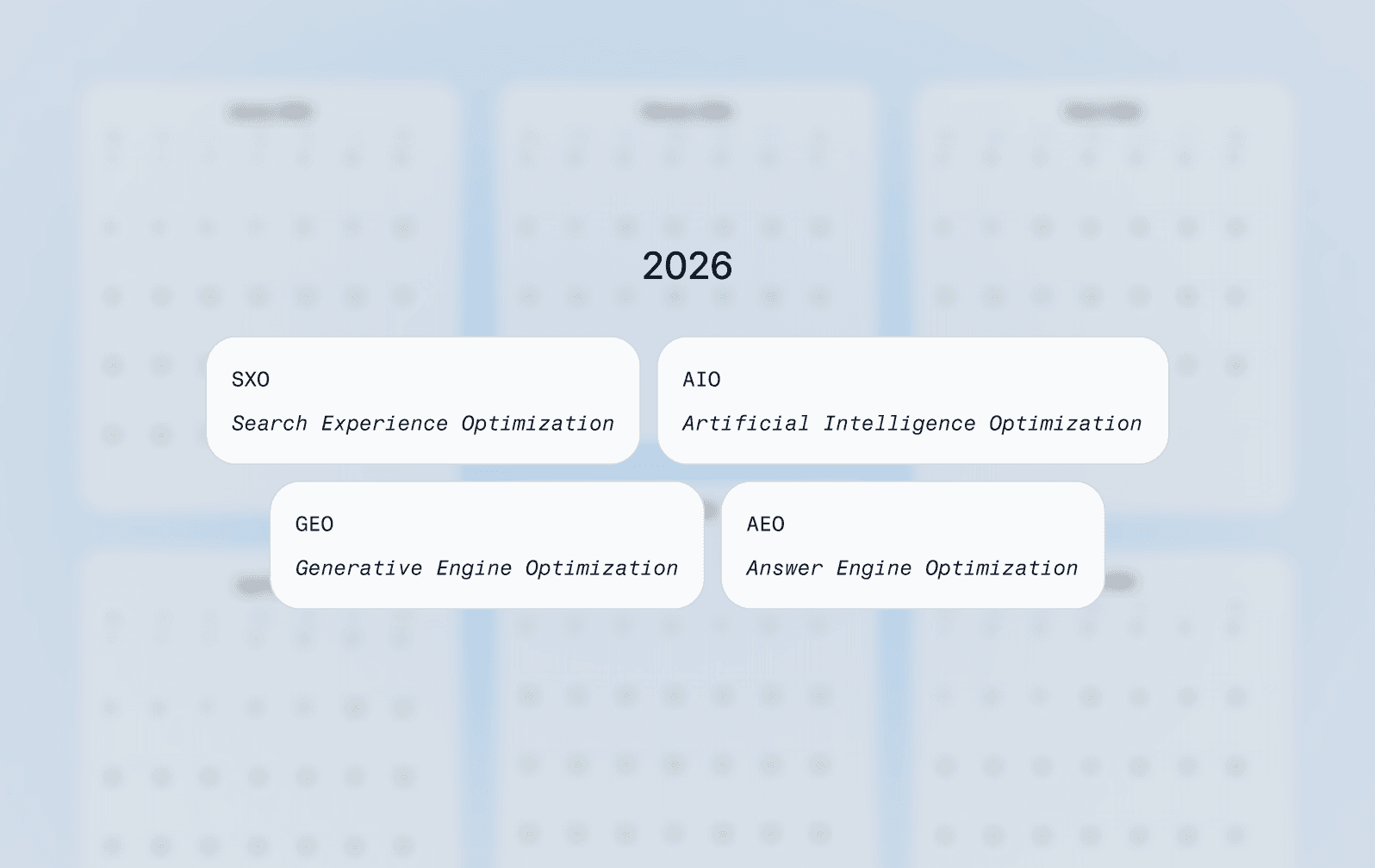
The new online visibility architecture is based on the synergy of SXO, AIO, GEO and AEO - four pillars that are shaping the future of optimization in the era of LLMs.
1. SXO - Search Experience Optimization
Search Experience Optimization combines SEO (visibility) and UX (user experience). Not only does a site need to rank high in Google, but it also needs to convert - that is, it needs to work quickly, intuitively and guide the user to their destination. SXO stands for:
- Charging speed: under 2 seconds
- Mobile-first: ~60% of traffic comes from the phone
- Optimization for intent: content tailored to the phase of the customer path
- Rigorous conversion testing: A/B testing, path analysis
- Monitor scroll depth and dwell time: indicators of real engagement
Ready-made script in javascript - load speed testing:
window.onload = function() {
  const tPageLoad = performance.timing.domContentLoadedEventEnd - performance.timing.navigationStart;
  if (tPageLoad > 2000) {
    console.warn('Page loads in over 2 seconds!');
  }
}
SEO that ignores user experience no longer works. It's SXO that converts users - not just displays the site.
Madhav Mistry, digital marketing strategist
2. AIO - AI Optimization
AIO (AI Optimization) prepares your site for AI algorithms and content automation. This allows not only Google, but also ChatGPT, Gemini or voice search to understand, pull and quote your content.
- Automatic linking: scripts (Python/JS) to add links between subpages
- AI drafting: tools like Jasper, ChatGPT API, Semly.ai
- Content Templates: repeatability without loss of quality
- AI audits: automatic analysis for technical, semantic and linking aspects
- Repurposing: distribution of content in various formats (text, video, graphics)
Fragment of phyton code - automatic linking:
import re
def auto_internal_links(content, related_terms, base_url):
    for term in related_terms:
        content = re.sub(rf"\\b{term}\\b", f'<a href="{base_url}/{term}">{term}</a>', content)
    return content
AIO is not just content created by AI, but the entire infrastructure ready for indexing, citation and processing by generative algorithms.
GVN Marketing
3. GEO - Generative Engine Optimization
GEO relies on brand citation by generative AI (e.g. ChatGPT, Perplexity). Here, it counts on being a source of data, summaries, research and an authority in a particular industry, not just as another link in Google.
- Data-backed content: own research, statistics, comparisons
- Structured formats: tables, quotes, infographics, FAQs
- Authority signals: clear "brand mention" and strong sources
- Citation hooks: content ready to be cited by LLM
Code snippet - markdown table for LLM:
| Service    | Research Results (2025)   |
|------------|---------------------------|
| Semly.ai   | 26% increase in GEO visibility|
| RedCart.pl | 17% GEO, 9% SXO           |
AI cites brands - and these citations are becoming the new currency of reputation, surpassing even traditional backlinks.
Luis Rijo - PPC-LAND
4. AEO - Answer Engine Optimization
AEO optimizes content for response engines (AI, Featured Snippets, voice search, zero-click answers). This is where structure matters - headline questions, one-sentence answers and schema markup.
- Headlines as questions:
<h2>What is SXO?</h2>+ one-sentence definition - FAQPage, QAPage, HowTo: schema.org for AI
- Short answers: quick, specific answers
- Question keywords: phrases typical of voice search ("how", "what is", "why")
Code snippet (json) - FAQ schema markup:
{
  "@context": "https://schema.org",
  "@type": "FAQPage",
  "mainEntity": [{
    "@type": "Question",
    "name": "What is SXO?",
    "acceptedAnswer": {
      "@type": "Answer",
      "text": "SXO is a combination of SEO and UX that optimizes the user experience from search to conversion."
    }
  }]
}
If you don't optimize for Answer Engines, your brand literally ceases to exist in AI results.
John Shehata, SEO Expert
FAQ
Why implement SXO if I have high positions in Google?
A high ranking is not enough - SXO gives real conversions, higher satisfaction and lowers the number of abandoned shopping carts.
Does the AIO require a specialized tool?
No, you'll implement the basics with simple scripts that automate linking or text analysis, and larger systems allow full AIO implementation.
How to get quoted by AI (GEO)?
Build expert, unique, well-structured content, publish your own data and research. AI cites qualitative sources with stated metrics and repeatability.
Is AEO important in e-commerce?
Key - FAQs, How-To, voice search, featured snippets are now the main access points to the store from Google, Bing and AI systems.
How long does it take to see noticeable growth with AIO/GEO/AEO?
In the technology and e-commerce industries, you'll notice the first results after just a few weeks of implementing changes to your website and content marketing.
Glossary
SXO (Search Experience Optimization): SEO + UX + CRO, focused on user experience and conversion.
AIO (AI Optimization): Optimization for AI/LLM algorithms and automation of content activities.
GEO (Generative Engine Optimization): Becoming a source of citations for AI generating responses.
AEO (Answer Engine Optimization): Optimization for response engines; content in FAQ format, Q&A, short answer voice search.
Schema markup: Structured data to facilitate the retrieval of responses from your site.
Zero-click traffic: Answer in Google/AI results without going to the site.
Summary
Want to win SEO in 2026? Identify the layers that are missing from your strategy and implement the complete package SXO, AIO, GEO, AEO. This is how you build an edge in the world of AI recommendations and modern search.
Share:
