

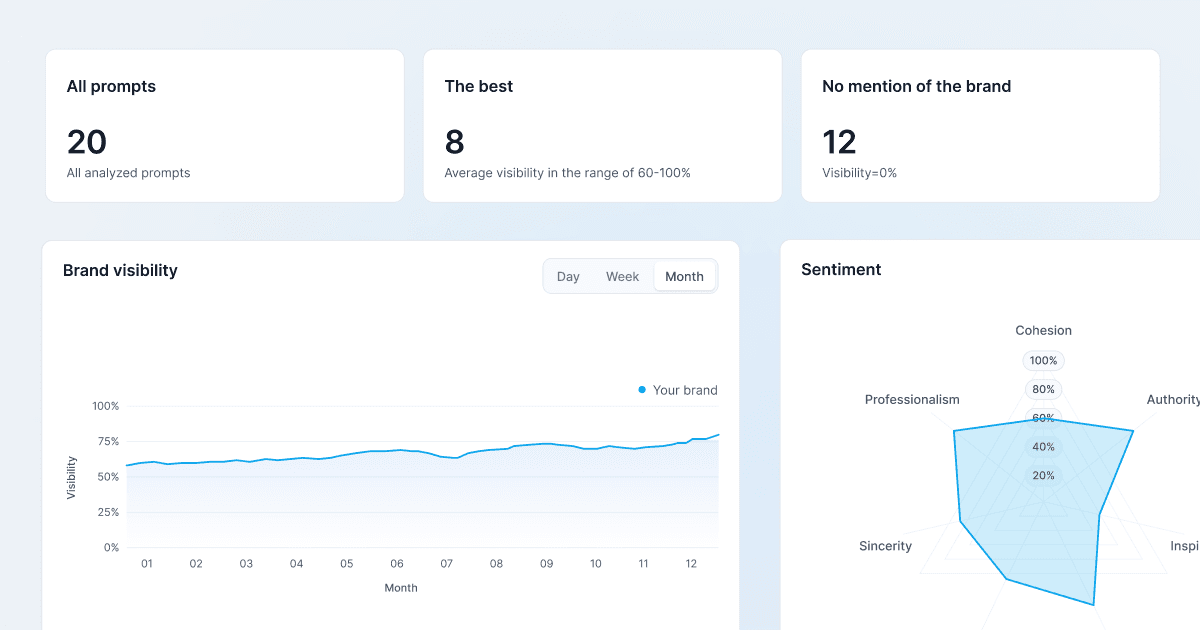
Until recently, most companies measured their visibility mainly on Google. Today, more and more customers seek answers in ChatGPT, Gemini, Claude, or Google AI. Before visiting a website, they ask AI about the best brands, products, or services.
This means that the way marketing effectiveness is assessed is changing. A good position in the search engine is no longer enough. It is increasingly important whether AI models mention your brand at all, how often they recommend it, and what sources they draw information from.
In this article, we will show which metrics are worth analyzing, how to interpret the results, and what to pay attention to in order to effectively increase brand visibility in AI responses.
Why is just ranking in Google no longer enough?
In SEO, we primarily measure rankings, clicks, and organic traffic. In the case of AI, the situation is different. Users often receive a ready-made answer without visiting any page. If the model does not mention the brand, it may not be considered by the customer at all, even if it performs well on Google.
SEO is still important, but it is worth supplementing it with separate monitoring of AI-generated responses.
| SEO | AI Visibility |
|---|---|
| Positions in Google | Brand presence in AI responses |
| CTR | Mention Rate |
| Links | Citation Rate |
| Search Console | Monitoring AI |
| Organic Traffic | Visibility in AI Models |
What is brand visibility measurement in AI and how does it differ from SEO?
Measuring visibility in AI involves regularly checking whether ChatGPT, Gemini, Claude, and other models mention the brand, recommend its products, and use its website as a source. Unlike traditional SEO, where the goal is to rank in the 'blue links', visibility in AI means being mentioned, quoted, or recommended by a language model in response to a user's query.
The scale of the phenomenon is already too large to ignore. ChatGPT currently has 900 million active users weekly, and traffic from AI platforms has increased year over year by 527%. Meanwhile, according to the Omni Eclipse study from March 2026, only 11.9% of companies are visible in ChatGPT for recommendation queries. This means that over 88% of brands are completely invisible to AI.
The fundamental difference between SEO and visibility in AI lies in the sources of citations. Research shows that only 6.82% of results cited by ChatGPT overlap with the top 10 Google results, and 83% of citations in AI Overviews come from pages outside the top ten search results. Therefore, ranking in Google does not guarantee visibility in AI. Moreover, brands can be present in AI responses in two ways: as a mention (brand mentioned without a link) or as a citation (brand mentioned with a clickable link to the site). Each of these modes has different business implications and requires separate measurement strategies.
Such monitoring can be done manually or automated using the platform Semly.ai. The tool regularly checks the responses of various models and shows how brand visibility changes over time.
Which visibility metrics in AI are worth measuring?
You don't need to start with dozens of metrics. Initially, the most important thing is to check if the brand appears in responses, how it compares to competitors, and whether AI directs users to its site. Other data helps assess whether visibility translates into traffic and sales.
Does AI know and recommend the brand?
Mention Rate (AI Signal Rate) - percentage of prompts in which a brand mention appears. Formula: (prompts with mention / all prompts) × 100%. Benchmark: above 30% is a good result. It's worth noting that ChatGPT mentions brands 3.2 times more often than it links to them.
A high Mention Rate means that AI models often include the brand when generating responses. However, it does not mean that the user will visit the company's website. To assess this, Citation Rate should also be analyzed.
Citation Rate shows how often AI cites the brand's page as a source and adds a link to it. This result is usually lower than the Mention Rate because models mention brands much more often than they refer to their pages.
A brand may be frequently mentioned by AI, but if the model does not cite its website, the chance of user visits is significantly lower. Citation Rate helps assess whether the brand's content is used as a source for responses. However, it should not be treated as a definitive measure of trust, as the choice of source is also influenced by the model, the type of query, and the method of information retrieval.
What is the difference between Mention Rate and Citation Rate?
| Aspect | Mention Rate | Citation Rate |
|---|---|---|
| What does it measure? | Does the brand appear in the AI response | Does AI cite the brand's page as a source |
| Affects recognition | Yes | Yes |
| Can generate traffic to the site | No | Yes |
| Informs about model trust | Partially | Yes |
| Best analyzed with | Citation Rate | Mention Rate |
Share of Model Voice (SoMV) - share of brand mentions against competitors. Formula: (brand mentions / total mentions of all tracked brands) × 100%. Benchmark for category leaders: 25-40%.
Share of Model (SoM) - brand presence in individual AI models. It's not enough to be visible in ChatGPT - you need to check presence in Gemini, Perplexity, Claude, and Grok, as models agree on top recommendations only 43.9% of the time.
Do users visit the site?
AI Recommendation CTR - the percentage of users who click on the brand link after receiving a recommendation from AI.
Share of Clicks - the share of clicks in AI compared to competitors within tracked prompts.
Does AI traffic translate to sales?
AI-Influenced Conversion Rate - the benchmark for optimized brands is 6.9%, while the average for Google organic is 1.8%. Users from AI recommendations convert 4.4 times better than the average from other organic channels.
AI Accuracy Rate - the percentage of correct brand information provided by AI (prices, contact details, product descriptions). Formula: (correct answers / all answers) × 100%. This is a critical metric - if AI provides false information, the brand loses not only traffic but also credibility.
Revenue Share from AI - the share of revenue generated by AI traffic in total revenue.
The Semly.ai platform in its framework monitors all the above metrics, automatically calculating them based on data from nine AI models and providing corrective recommendations in case of deviations from benchmarks.
Mention Rate vs Citation Rate - two worlds of visibility in AI
If a brand has a Mention Rate of 60%, but a Citation Rate of only 2%, AI often mentions it but rarely directs users to its site. In such a case, it's worth checking which sources the models cite instead of the brand's site and what is missing in its own content.
Overview of AI visibility monitoring tools - comparison table
AI monitoring tools differ in the number of supported models, measurement frequency, and the way results are presented. The following summary facilitates the comparison of the most important solutions. Prices were checked in July 2026 and may change.
| Tool | Price from | AI Models | Key Features | For whom |
|---|---|---|---|---|
| Semly.ai | €39/month. | up to 7 models | Monitoring + repair recommendations, e-commerce and services | Brands, services, and e-commerce |
| KIME | €149/month | 10 models | Action Centre, AI Perception, daily monitoring | Enterprise |
| Profound | $99/month | up to 10 models | Panel data, CDN attribution, SOC 2 | Enterprise |
| Peec AI | €85/month | up to 10 models | Unlimited number of users, support for multiple languages | SMB |
| Semrush AI Toolkit | $199/month. | 5 models | Integration with SEO toolkit, competitive intelligence | SEO teams |
| Otterly.AI | $29/month. | 4 models | GEO audits, unlimited number of users | Startups |
| HubSpot AEO Grader | Free | 3 models | 5-dimensional scoring, snapshot | Everyone (point-based) |
| Nightwatch | $32 + $99 AI | 4 models | SEO + AI visibility, white-label | Agencies |
| SE Visible | $99/mo. | 5 models | Multi-brand, sentiment analysis | Agencies |
| AirOps | Free tier | up to 4 models | Content ops + AI visibility | Content team |
| Searchable | $50/month. | up to 7 models | Content Studio, CRM integrations | Marketing ops |
| Alhena AI | Individual pricing | Multi-platform | AI Shopping Assistant, revenue attribution | E-commerce |
| Kalicube | Individual pricing | Multi-platform | Entity-focused, Knowledge Graph | Brand visibility |
Three paths to choose a tool:
- Just starting out - start with the free HubSpot AEO Grader (one-time visibility snapshot in ChatGPT, Perplexity, and Gemini) and free visibility report from Semly.ai, which will show in two minutes whether AI recognizes your brand at all.
- I have an operational budget - Semly.ai (€39/month), Peec AI (€85/month), or SE Visible ($99/month) offer solid monitoring of several models with competitive analysis and sentiment.
- Enterprise - Semly.ai, KIME (€149/month) or Profound ($99/month starter) provide advanced features, including data panels from real users and integrations with CDN infrastructure.
You can perform the first measurement yourself. Choose 10-15 questions that your customers actually ask, then check them in ChatGPT, Gemini, and Perplexity. In a spreadsheet, note whether the model mentioned the brand, what position it placed it in, whether it added a link, and what the tone of the response was. This test won't replace regular monitoring but will show you where you start.
Why a single measurement is not enough? The variability of AI responses
The AI model can provide slightly different answers each time, even if we input exactly the same question. The study by Schulte, Bleeker, and Kaufmann from 2026 titled "Don't Measure Once" proved that visibility in AI should be treated as a statistical distribution, not a single data point. Therefore, one measurement can give a misleading picture of visibility.
In practice, the differences between successive measurements can be significant. According to BrightEdge, the monthly churn of quotes in ChatGPT is 40-60%, and Alhena AI documented that AI Share of Voice can drop by 35.9% in just five weeks. This means that a brand visible today may be completely absent in a month.
It is therefore worth checking the results regularly. A weekly measurement is sufficient to observe the overall direction of changes, while daily monitoring allows for quicker detection of larger declines.Tools like Semly.ai automate this process by taking measurements regularly and reporting trends rather than single values. This allows marketers to distinguish temporary fluctuations from actual downward trends and react before a loss of visibility translates into a drop in traffic.
Why it’s not worth checking only ChatGPT?
ChatGPT, Gemini, Claude, or Perplexity may use different sources and recommend different brands. A good result in one model does not mean that the brand will be equally visible in others.
| AI Model | Source Preferences | Implications for Strategy |
|---|---|---|
| ChatGPT | Long content (>20,000 characters, 4.3x more quotes), current (<10 months), statistics (+40% quotes) | Create comprehensive data guides and update them regularly |
| Gemini | .gov/.edu domains, official sites, structured data | Strengthen E-E-A-T and implement Schema.org in JSON-LD format |
| Perplexity | Original publications, Reddit, fresh content | Publish original research and build a presence on Reddit |
| Claude | UGC 2-4x more often than other models, Reddit, Quora | Invest in presence on forums and social media platforms |
| Grok | 27% Citation Rate (highest), content from X (Twitter) | Be active on X and publish short, engaging content |
Only 11% of domains are cited by both ChatGPT and Perplexity. The same brand can have a 615-fold difference in citation volume between Grok and Claude. Therefore, it is not worth evaluating overall visibility solely based on ChatGPT. Only by comparing several models can we see where the brand is strong and where it is losing to competitors. Semly.ai monitors brand presence across all key models simultaneously, allowing identification of where the brand is strong and where it needs improvement.
How to start monitoring brand visibility in AI?
Week 1 - Audit
- Define 20-50 key prompts (sources: Google Search Console, AnswerThePublic).
- Manually check visibility in ChatGPT, Gemini, and Perplexity.
- Document results in a spreadsheet (template above).
- If you want to automate this, Semly.ai will perform the audit in 2 minutes - free visibility report.
Week 2 - Tools
- Choose a monitoring tool according to the selection path.
- Set up monitoring for your brand and 3-5 key competitors.
- Connect Google Analytics 4 and Google Search Console.
- Semly.ai monitors up to 7 AI models simultaneously, so the setup covers all key platforms at once.
Week 3 - Optimization
- Analyze the first results from the tool.
- Implement quick wins: Schema FAQ/HowTo, update publication dates, add statistics to top content.
- Report incorrect brand information (improve AI Accuracy Rate).
Week 4 - Analysis and Correction
- Compare results from week 1 and week 3.
- Identify content most frequently cited by AI.
- Create a GEO content plan for the next month, considering the preferences of individual models.
Checklist:
- defined prompts
- selected tool
- competitor monitoring
- Schema on the page
- updated dates
- first comparative report
How to track traffic from AI in GA4 and GSC? (technical aspects)
Traffic from ChatGPT, Perplexity, and other AI tools can be partially tracked in GA4. However, it should be noted that a large portion of users end their searches with the answer itself and never visit the site.
Google Search Console: Google does not provide dedicated traffic data from AI Overviews - they are included in the overall organic results. However, one can observe an increase in impressions and clicks for informational queries, which indirectly indicates presence in AI Overviews.
Google Analytics 4: Use the Explorations tool to create the segment "Traffic from AI". The ready regex for filtering source/medium:
.*chatgpt.*|.*perplexity.*|.*gemini.*|.*claude.*|.*copilot.*|.*grok.*|.*deepseek.*Step by step instructions: Explorations → New → Segment "Traffic from AI" → Dimensions: Source/medium, Landing page → Metrics: Sessions, Conversions, Revenue.
Limitations: Traffic from AI still constitutes a small part of all entries on most pages, so initially, large numbers should not be expected. Moreover, 93% of AI Mode sessions end without a click, meaning a significant portion of visibility remains unseen in standard analytics.
AI Bots: It is also worth checking server logs to see which pages are visited by AI bots, including GPTBot, ClaudeBot, and PerplexityBot. Analyzing which pages AI bots visit helps understand what content the model considers valuable sources of knowledge.
Case study: how brands increased visibility in AI and translated it into sales
Before starting actions SportFuel scored 12 points in AI Visibility Score. After three months, the score rose to 54 points. During the same period, the brand was recommended more often by ChatGPT and Gemini, and traffic from these sources began to result in purchases more frequently. Recommendations by ChatGPT and Gemini increased by 445%, and sales from AI channels rose by 8%. Key detail: conversion from AI traffic was 6.9% compared to 1.8% from Google Ads, and the cost per acquisition (CPA) dropped from 48 PLN to 0.50 PLN.
RedCart - the e-commerce platform recorded a 25% increase in customer registrations and a 30% increase in conversions from trial to paid subscription after implementing GEO optimization. The AI Visibility Score tripled - from 12/100 to 45/100.
In both cases, key actions included: optimizing the product feed for AI understanding, implementing Schema Product and FAQ, publishing expert guides with numerical data, and systematic monitoring in Semly.ai with weekly corrective recommendations.
Summary and Next Steps
Five key takeaways from this guide:
- Customers are already using AI today to choose products, services, and specific brands. 37% of consumers start their search with AI, and Gartner predicts a 25% decline in traditional search volume by the end of 2026.
- You need new KPIs - Mention Rate, Citation Rate, SoMV, and AI Accuracy Rate are metrics that replace traditional Google rankings.
- Measure regularly, not just once - the variability of AI responses makes a single measurement worthless; weekly monitoring is necessary.
- Each AI model has different preferences - the strategy must be multi-model, tailored to the specifics of ChatGPT, Gemini, Perplexity, Claude, and Grok.
- Well-planned GEO actions can increase the number of recommendations and bring valuable traffic to the site. However, their impact should be assessed based on data collected over a longer period.
Next step: Want to check where you start? Generate a free Semly.ai report and see if the most important AI models recommend your brand. You will receive a starting point for further monitoring and improving results.
Share:
