

Check your company's visibility in AI
Free, no credit card required.
A customer can learn about a company in a conversation with AI, compare solutions, and only later type the provider's name into Google. The traffic source report will then show an entry from the search engine, even though the assistant may have played a role in the brand choice. To assess the significance of this process, three things must be distinguished: recommendation, visit to the site, and sales effect.
What did the Demandbase study show?
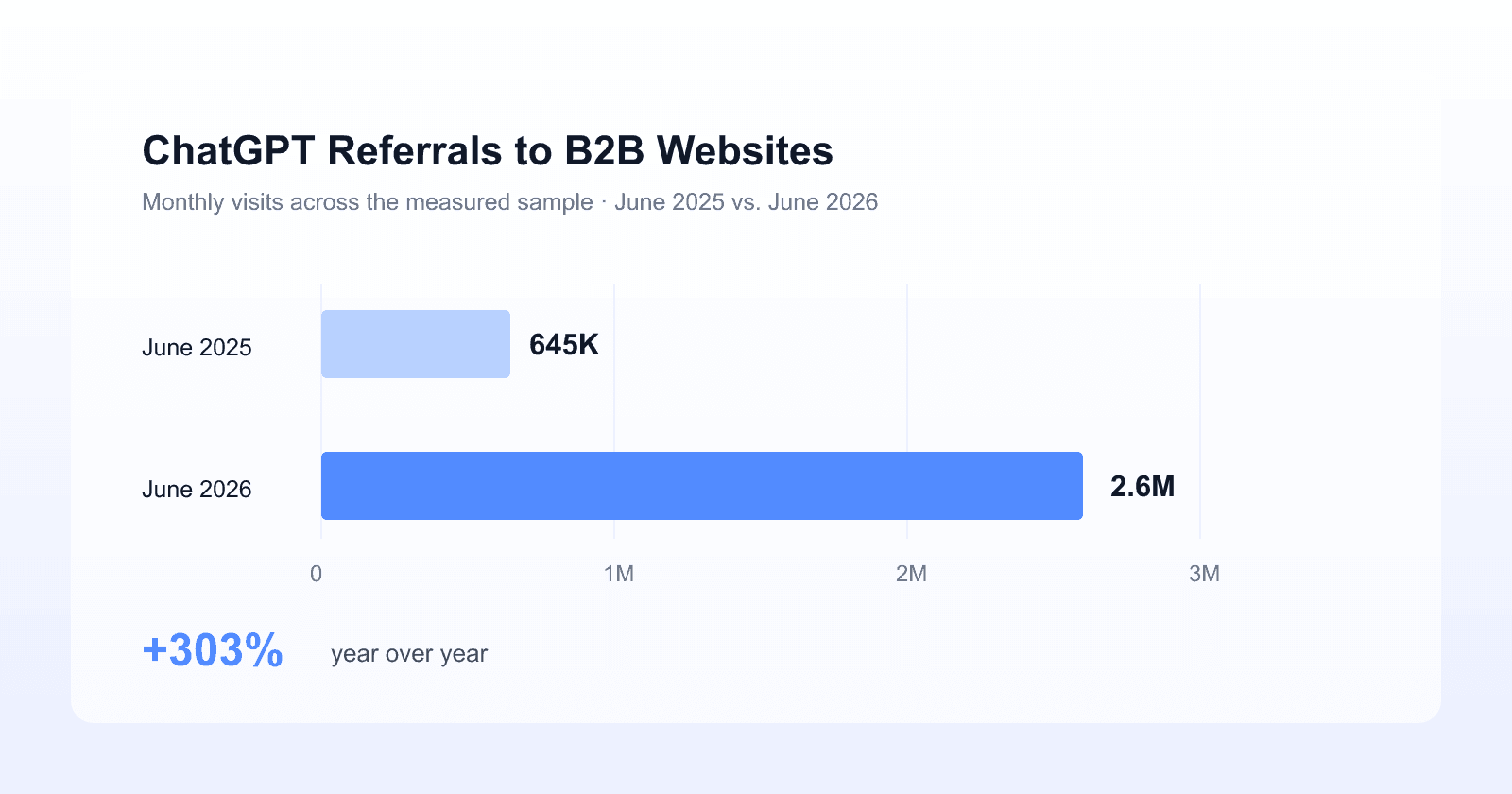
The message published on August 12, 2026, concerns user transitions after clicking a link in the AI assistant. The dataset included over 11 billion visits and 1584 distinct instances of the Demandbase platform. This number should not be equated with the confirmed number of unique companies.
| Parameter | Result |
|---|---|
| Transitions from ChatGPT in June 2025 | approximately 645 thousand |
| Transitions from ChatGPT in June 2026 | about 2.6 million |
| Year-over-year change | +303% |
| Period of the entire dataset | June 1, 2025 – July 31, 2026 |
Monthly values are the sum for the studied sample, not the average per company. ChatGPT accounted for growth, while transitions from Perplexity decreased, and Gemini and Claude remained at a similar level. Source and methodology: Demandbase.
The result justifies checking your own data. It is not a growth forecast for a single site nor evidence of proportional sales growth. An assessment of the quality of contacts, the cost of acquiring them, and the value of contracts is still needed for budget decisions.
Why does GA4 not show the full impact of AI recommendations?
Suppose the sales director asks the assistant about a CRM system for a company employing 50 salespeople. They receive several proposals, discuss them with the team, and after two days, search for one of the providers on Google. This is an example of a path where the brand discovery moment and visiting its site are separated.
If a user clicks on a free Google result, a correctly recognized visit will usually have the source and medium google / organic. Clicking on an ad may go to the paid channel. The designation direct / none indicates a lack of recognized source. Simply searching for the brand name does not make the visit a direct entry. GA4 traffic source documentation, explanation of direct traffic.
The session source shows where the user came from to the site. It does not always show where they first learned about the brand.
This distinction has practical consequences. Adding a separate channel group for AI organizes recognized transitions but does not recreate conversations that took place earlier outside the site. Therefore, it is worth presenting traffic assigned to AI platforms separately in the report and signals of their possible impact on brand interest.
What do the Similarweb numbers mean: 8.8% and 55.9%?
Similarweb analyzed visits after brand recommendations in ChatGPT. In the studied paths, 8.8% of visits came from the AI channel, 55.9% from search engines, 19.9% from direct entries, and 13.5% from other referrals. Source: Similarweb.
Visits after brand recommendations in the Similarweb sample. The shown categories sum up to 98.1%; the remaining share is not detailed in the referenced summary. Source: Similarweb.
The analysis concerned computer users in the USA, sectors of finance, tourism, and beauty, and the period from July to December 2025. Seven days were observed after the recommendation. Individuals who visited the brand's website in the previous four weeks or mentioned its name in the query were excluded. This is a different sample than the B2B Demandbase set.
The rate 55.9% describes traffic from search engines, not solely searches for the brand name. It must not be presented as the share of brand queries. Source: The Downstream Impact of AI Visibility.
The study indicates that the recommendation and subsequent visit may occur in different channels. It does not provide a universal conversion rate for B2B companies or a basis for considering every subsequent visit as caused by AI.
How does the way of presenting answers affect the number of visits?3
In a separate analysis, Similarweb described more visible links to brands in ChatGPT responses from May 7, 2026. A comparison of the week before and after the change showed an increase in visits by 157.7%. The share of visits directed to homepages increased from about 26–32% to about 60%. The study covered the desktop panel from April 30 to May 20, 2026. Source: Similarweb.
The conclusion for the company: the increase in traffic after updating its own site must be compared with changes on the platform side. More sessions do not necessarily mean that the brand started appearing more often. It could also be easier for users to click the link.
In the monthly report, it is worth comparing three indicators: the frequency of brand presence in monitored responses, the number of recognized visits, and the number of valuable contacts. If only the second indicator is increasing, it is necessary to check the way links are presented, landing pages, and changes in measurement before attributing the result to one's own actions.
Do bot visits mean more customers from AI?
Automatic content retrieval from a site and user transition from an assistant are separate events. Cloudflare documentation separates crawler requests from referral traffic from AI platforms and allows them to be analyzed separately. Source: Cloudflare AI Crawl Control.
A bot retrieving a page, a brand recommendation, and a customer visit are three different events. Each requires separate measurement.
Server logs help detect issues with content access. Response monitoring shows whether the brand appears for selected questions. Site analytics describes visitor behavior, and CRM allows assessing contacts and sales opportunities. None of these sources alone describes the entire process.
Therefore, the observation that bots from one provider retrieve the page more often is not sufficient to compare the marketing effectiveness of assistants. Before such a conclusion is drawn, it is necessary to define the type of measured events, the period, and the scope of data.
How to measure the impact of AI on B2B customer acquisition?
We propose a report that maintains the distinctiveness of each stage while allowing for the exploration of relationships between them.
| Measurement Area | What to Observe | How to Interpret |
|---|---|---|
| Brand visibility | Presence in responses to a fixed set of questions | The result pertains to the monitored sample, not all user conversations |
| Traffic from AI | Identified sessions, landing pages, and conversions | Shows visits with available source information |
| Brand interest | Inquiries containing the company name and customer information | Requires consideration of campaigns, PR, and seasonality |
| Sales | Qualified contacts, opportunities, and revenue | Needs time corresponding to the sales cycle |
| Content availability | Bot requests and server response errors | Helps diagnose access, does not prove recommendations |
1. Build a set of questions from the purchasing process
The starting point should be sales conversations, requests for proposals, and issues reported by customers. The set may include questions about solution category selection, required integrations, implementation constraints, and vendor comparisons.
For example, a company offering a CRM system may monitor the question: “Which CRM to choose for a field sales team that needs offline work?”. Such a question allows checking presence for a specific need. Separately, it is worth analyzing questions containing the company name to avoid mixing the discovery of new vendors with the verification of an already known brand.
2. Maintain comparability of measurements
Establish the language, market, set of questions, and platforms. Record dates and test conditions. Evaluate changes based on multiple measurements, and after modifying the question set, mark the break in comparability. Otherwise, a better result may reflect easier questions rather than actual improvement.
It is also useful to separate the mention of the brand from indicating its page as a source. We expand on this topic in the Semly report on e-commerce visibility in AI responses. The scope of this report differs from the analyses discussed here; it serves as a complement to the measurement method.
3. Combine analytics with the quality assessment of contacts
In GA4, analyze recognized entries from AI and actions relevant to the business: form submissions, signing up for a demo, or initiating contact. Then check in CRM how many submissions meet the target customer criteria and proceed to the next sales stages.
Always show the conversion rate together with the sample size. Two conversions out of ten sessions give 20%, but do not yet constitute a stable basis for forecasting. Also consider the delay between the first visit and signing the contract. You can read more about this process in the articlehow to measure and report sales with AI Search.
4. Collect customer declarations without suggesting answers
The question "Where did you first hear about our company?" can supplement technical data. Allow for open-ended responses and record them in CRM. If the customer indicates the AI assistant, it is worth clarifying what they were looking for and what information helped them make their choice.
Treat such declarations as an additional source of knowledge. Customer memory can be incomplete, and several people may be involved in the decision. Do not automatically assign the entire value of the contract to one indicated contact with the brand.
5. Evaluate changes in the context of the remaining marketing
Maintain a shared calendar of publications, campaigns, events, and changes in offerings. If visibility in AI and interest in the brand are increasing, check if a marketing campaign or media publication has launched at the same time.
When on a larger scale, compare groups of topics or pages subject to changes with similar groups without changes. Such a layout can strengthen the assessment of effects, although it still requires monitoring differences between groups. A simple correlation is not sufficient to confirm causation.
What to improve on the page to allow the user to verify the recommendation?
Start with the content needed for decision-making: clearly describe the target audience of the solution, applications, integrations, implementation conditions, and limitations. In case studies, show the starting point, actions taken, and how results were calculated. Update information that may change.
It's also important to ensure clear navigation between the guide, product description, and contact. A user who arrives at the homepage via a recommendation should quickly find confirmation that the offer meets their needs.
In the context of presence in Google AI Overviews and AI Mode, Google points to the basics of SEO: accessibility for bots, internal linking, important information in text form, and structured data aligned with the content. No special marking 'under AI' is required. These are guidelines for Google features, not a guarantee of citation by any assistant. Source: Google Search Central.
Frequently Asked Questions about Traffic from ChatGPT
Does a 303% increase mean an increase in overall B2B traffic?
The result pertains to transitions from ChatGPT in the Demandbase trial. It does not describe the total site traffic or the increase in the number of customers. Source: Demandbase.
Does 55.9% mean brand name searches?
Similarweb describes this metric as the share of traffic from search engines in visits analyzed related to AI recommendations. This is not a measure limited to brand queries. Source: Similarweb.
Does GA4 measure all visits resulting from AI recommendations?
GA4 can recognize the source of a visit when the appropriate information is available. It does not automatically identify a prior conversation with the assistant, after which the user entered the site through another means. Source: GA4 documentation.
How to start measuring AI effects in a B2B company?
Start by establishing purchasing questions, measuring brand presence, and isolating recognized traffic from AI. Then, it’s worth linking this data with contact qualification in CRM and customer responses about how they learned about the company.
Check if AI considers your company when choosing a provider
Start with the questions your product or service answers. Check if the brand appears in the responses, how it is described, and with which competitors it is compared. Only based on this, choose the information and materials that need to be supplemented.
Check your company's visibility in AI for free. Compare monitoring results with site analytics and CRM to assess both brand presence and the quality of acquired contacts.
Methodological note: this article is based on public analyses from Demandbase and Similarweb and tool documentation. It does not present its own traffic research from Semly. The attempts and periods of individual analyses vary; measurement recommendations are editorial comments. Source verification status: September 21, 2026.
Share:
