

Check your business visibility in AI
Free, with no credit card required.
Where does Perplexity get information about companies and tools?
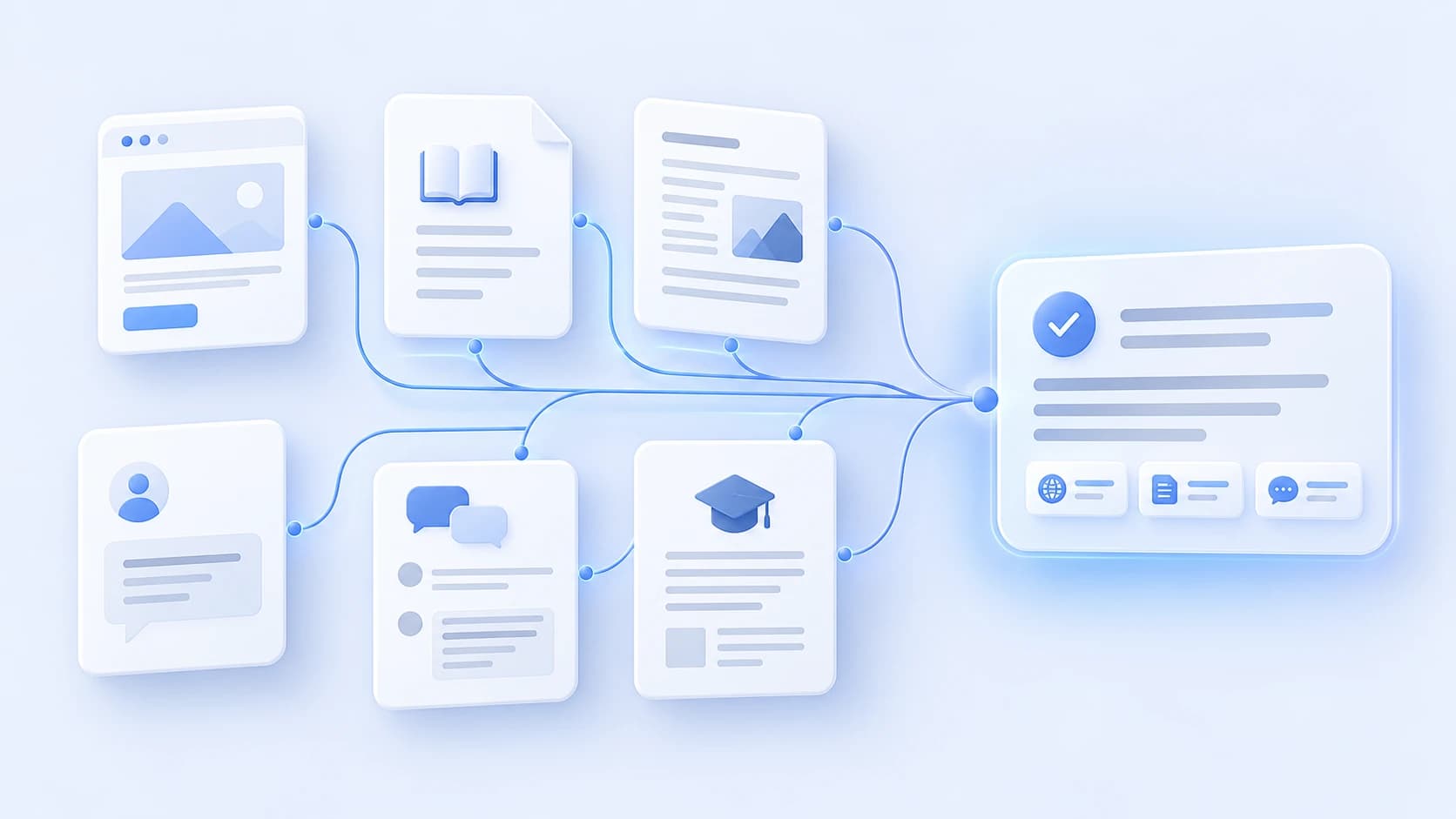
Perplexity searches the web and combines information into an answer with source links. Pro Search documentation lists articles, academic papers, forums and videos. The material types depend on the selected search approach. Source: Pro Search documentation.
When assessing a company or software recommendation, group sources into vendor materials, comparisons, reviews, industry publications and user experiences. This is a practical audit classification. It does not mean every answer uses all groups or assigns them fixed weights.
Consider the question: "Which tool can help an agency check brand visibility in AI answers?" The customer needs information about use cases, analysis scope and workflow. "Does a particular tool offer this integration?" requires different evidence. Start source analysis with the user's need.
The most useful list for your business contains pages cited for your customers' questions. A general list of popular domains does not show which publications support recommendations in your category.
Which source types should you check in recommendations?
This table helps classify materials found in citations and identify information you can verify. It is not a ranking of Perplexity sources.
| Source type | What you can verify | What to watch for |
|---|---|---|
| Official company website | Uses, service scope and contact details | General promises without explaining the intended audience |
| Documentation and help center | Features, integrations, instructions and limitations | Outdated descriptions or instructions for a different version |
| Pricing and offer terms | Plans, limits and usage conditions | Prices without a date, market, currency or plan |
| Tool comparison | Selection criteria and differences between solutions | Missing methodology, unclear partnerships or outdated data |
| Review and test | Usage experience, strengths and limitations | An assessment without explaining what was actually tested |
| Industry publication | Market context, expert commentary and new information | A republished release presented as independent findings |
| Forum and user discussion | A specific problem, implementation and experience | One opinion treated as every customer's experience |
| Directory and company profile | Name, category, website address and basic description | An incorrect category or details for another company |
| Report and research material | Results, definitions, methodology and research scope | Numbers without a sample, period or measurement explanation |
Company website and documentation
A vendor's website should let readers check what the product does, whom it serves and its limitations. Documentation should expand on this with feature explanations, integration conditions and user steps.
If an answer misrepresents a feature, review both the destination page and help materials. Changing a homepage headline alone may leave contradictory information in an older guide.
Comparisons, rankings and reviews
A comparison can explain why a tool fits a particular situation. Assess whether the author tested it, whom the conclusions address and when the information was updated.
Names such as G2, Capterra and Trustpilot can help organize a profile and review audit. These are examples to check, not a confirmed list of domains Perplexity always prefers. Their relevance to your business must be assessed through specific pages appearing in observed answers.
Forums, communities and user experiences
Look for accounts of actual situations: an implementation problem, feature use, limitation or solution. An integration difficulty requires different information from a question about a product's basic use.
Reddit and industry forums are examples to investigate. Do not assume one popular thread determines recommendations for an entire brand. Check its date, context and the author's factual claims.
Industry publications, directories and reports
An industry article may offer original findings; a directory may help identify a company. Distinguish these roles. A profile linking to a website does not verify product results, and a press release does not become an independent test when several websites publish it.
Check a report's definitions and methodology. If it discusses "AI visibility", it should explain whether this means mentions, recommendations, citations or another metric.
Does Perplexity use only public websites?
Not in every scenario. Perplexity also describes search combining the web, uploaded files, connected apps and saved context. Available resources depend on configuration and the features used. Source: Perplexity Search.
For a brand audit, record test conditions. An answer based on an uploaded company presentation addresses a different research question from an answer without that material. The former tests document interpretation among other things; the latter observes information available in that search.
Do not treat a result obtained after uploading a company PDF as proof that an ordinary user will discover the brand in the same way. Record the materials and instructions available in the conversation.
Is there a fixed list of sources Perplexity prefers?
The referenced documentation describes source types and search features. It does not provide a complete domain list with fixed weights determining company and tool recommendations. It therefore does not support a rule such as: "Publishing on this website guarantees a brand recommendation."
Agent API documentation also describes domain, date and location filters. These API features should not be equated with default settings in every app conversation. They do show why search configuration belongs in a test description. Source: Perplexity Web Search.
The practical conclusion: map sources for a specific market, language and question set. Treat the map as an observation from a defined period that needs updating, rather than a universal Perplexity ranking.
How can you check the source of a specific recommendation?
Read the answer and open links associated with important claims. A domain name alone is insufficient. The page's content and what it actually supports matter.
- Record the question and conversation conditions - include language, market, date, mode, additional files and instructions
- Identify the recommended company or tool - note the need it addresses and the justification provided
- Open the cited pages - record full URLs, titles and publication dates where available
- Connect claims to sources - check whether the publication supports the feature, price, use case or assessment attributed to the brand
- Record discrepancies - separate outdated information, misinterpretation and missing evidence
For example, Perplexity recommends software "for agencies managing multiple brands". One citation leads to a general software list and another to feature documentation. Check whether either discusses managing multiple brands. Two links do not automatically substantiate the justification.
A citation and a recommendation are different signals. A source may confirm a limitation; a company may appear as an example without endorsement. Assess its role in the entire answer. Perplexity itself recommends checking information through source links. Source: Pro Search guidance.
How can you audit sources for your business?
Start with customer questions
Prepare question groups separating solution discovery, offer comparisons and checks on a specific brand. A question naming the company will not show whether AI independently considers it when selecting a provider.
- Category question: "How can you check whether AI recommends your company instead of competitors?"
- Use-case question: "Which tool helps an agency analyze AI answer sources?"
- Comparison question: "How does AI visibility monitoring differ from tracking Google rankings?"
- Brand question: "What does Semly do and who is it for?"
These are research preparation examples, not actual query results. Adapt them to your offer and customers' language. Keep questions without the brand name separate from brand questions.
Record specific pages and their roles
This worksheet turns citations into tasks for SEO, content and PR. Each row should concern one page and an observation from an answer.
| Audit field | What to record | Purpose |
|---|---|---|
| Question and conditions | Exact prompt, language, market, mode and date | Comparing similar tests |
| Cited page | Full URL, title, author and available date | Reaching material for verification |
| Source type and owner | Documentation, review, forum, owned or external material | Understanding the publication's nature |
| Citation role | Feature, price, use case, opinion or limitation | Checking the answer's justification |
| Brand and context | Recommendation, neutral mention or criticism | Separating presence from endorsement |
| Information accuracy | Confirmation, outdated information, discrepancy or missing evidence | Selecting information to correct |
| Action and owner | Documentation update, editor contact or new material | Implementing and checking completion |
Watch for duplicated material. Five domains publishing the same announcement may mean five publication locations but one original information source. Record the URL and the material's origin.
Repeat measurements under comparable conditions
Retain the question set and record setting changes in subsequent measurements. Do not combine app answers, another mode and a custom API integration into one series without describing the differences.
If a domain appears in 8 of 20 observed answers, you can report that 40% cite it. This is an example audit metric. It does not measure the domain's share across all Perplexity answers or the strength of its influence on recommendations. State the observation count and measurement period.
Read about recommendation variability in Why does Perplexity recommend a brand one day and leave it out the next?.
How can you use source analysis in Semly?
Semly helps monitor brand visibility in AI answers, compare it with competitors and analyze cited sources. Its product page describes citation rankings and viewing answers together with their citations. Source: AI visibility monitoring in Semly.
A team can start with questions where AI includes competitors, inspect cited materials and identify information about its own offer that needs improving. Analyze brand presence, context and sources together. A domain's position in a citation list does not explain the whole recommendation.
Combine monitoring with a simple action log: what changed, in which material and when. This lets you compare later answers with earlier observations. Semly documentation describes regular analysis of prompts, brands, competitors and sources. Source: how AI monitoring works in Semly.
Monitoring reveals changes. Attributing one to a specific publication also requires considering other changes to the offer, sources and measurement conditions.
What should you improve if Perplexity omits or misrepresents your business?
Align information on your own pages
Check the product name, category, uses, current features and offer terms. Explain whom it helps, in which situation and what it does not cover. Remove contradictions between product pages, documentation and company profiles.
For an incorrect answer, start with the cited page. If that content is correct but the answer distorts it, record an interpretation issue. Do not change an accurate product description merely to match an incorrect result.
Check search accessibility
Perplexity describes PerplexityBot as helping surface and link websites in search results. It recommends checking access in robots.txt and site security rules. Verification should use current documentation, including published IP ranges. Source: Perplexity Crawlers.
Ask the website owner to check whether important materials return errors or access blocks. Resolving an access problem makes content readable; it does not guarantee selection for an answer.
Complete and update external material
Correct cited profiles with an incorrect category or old address. If a comparison describes an outdated feature, send the author current documentation and identify the specific discrepancy.
Build new material around a customer question: a use-case test, limitation explanation, process comparison or implementation account. Disclose collaboration and base conclusions on what was actually checked.
Read more about planning publications in How do external brand mentions influence AI recommendations?.
Does making a page accessible mean training a model on it?
Searching for and reading a page should not be equated with model training. Perplexity states that PerplexityBot does not collect content to train foundation models. It separately describes Perplexity-User, which may visit pages in response to user actions and also does not train those models. Source: Perplexity bot descriptions.
This distinction helps define the right goal: improve information accessibility and quality, examine its use in answers and correct discrepancies. Publishing an article does not automatically mean a model has been trained on it.
Frequently asked questions about Perplexity sources
Does Perplexity use company websites?
A company website can be a search source. To check its use in a specific answer, open citations and compare the page with the company description. Website accessibility alone does not ensure a recommendation.
Does a G2 or Capterra listing guarantee a recommendation?
There is no basis for treating a profile on a particular website as a guarantee. Check whether the specific page is cited for your customers' questions and contains current, useful information.
Does a link in an answer confirm that Perplexity recommends a company?
A link identifies an information source. It can support a feature description, limitation or criticism. The answer's content and whether the company is presented as meeting a need determine whether it is a recommendation.
Are sources the same in the app and API?
Do not assume they are identical. Agent API offers source, date and location filter settings. Record how the test was performed and consider those settings when comparing results.
How often should you check answer sources?
Repeat measurements on a fixed schedule and after substantial changes to the offer, documentation or external publications. Assess a series under comparable conditions. One conversation represents one observation.
How does Semly help analyze cited sources?
Semly shows sources appearing in observed AI answers and the presence of the brand and competitors. Citation analysis helps select material to verify; subsequent measurements allow teams to observe changes.
Sources and scope
This article uses public Perplexity and Semly documentation checked on October 2, 2026. Source categories, the audit worksheet and example questions are editorial suggestions. They do not represent citation-frequency research, Perplexity test results or a disclosed recommendation algorithm.
- Perplexity: What is Pro Search?
- Perplexity: Search
- Perplexity: Web Search in Agent API
- Perplexity: Crawlers
- Semly: AI brand visibility monitoring
- Semly: how AI monitoring works
Share:
