

Check your company's visibility in AI
For free, no credit card required.
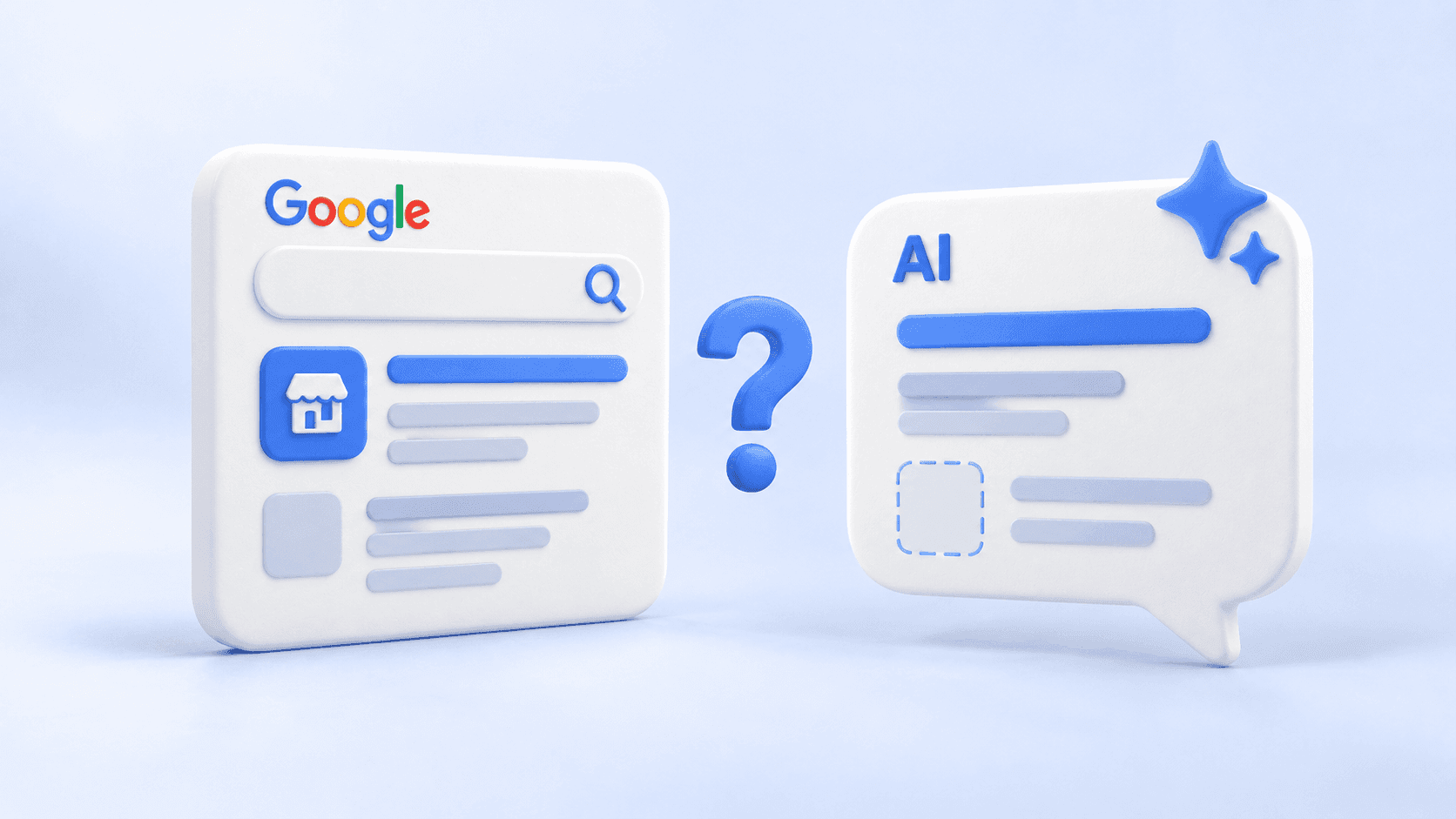
Your site appears on Google. Customers find guides, product categories, and offers. However, when they ask AI for a solution to their problem, the answer points to other companies.
Such a discrepancy does not necessarily mean that SEO has stopped working. It may indicate that the site's visibility pertains to different questions than those for which the user expects recommendations. It may also reveal a lack of information linking the brand to a specific need.
Presence in Google results, citing the page, brand mention, and company recommendation are four different events.Only separating them allows us to determine what needs improvement.
At Semly, we propose a diagnostic framework:
Google visibility → source visibility → brand mentions → AI recommendations
It helps check whether the issue relates to finding content, using it as a source, brand recognition, or indicating it as a solution for the client.
Why good visibility on Google does not guarantee AI recommendations?
In classic Google results, the user receives a list of pages and chooses which ones to read. In response, AI can immediately see a comparison, explanation, or solution proposal.
These situations require a different kind of information.
A guide on choosing a mattress may well answer an educational question. However, it does not have to provide the basis for recommending a manufacturer to someone looking for a specific size, return conditions, and the ability to test the product.
Similarly, a service company's page may appear for the brand name but not clarify whether the company serves a specific type of client or project scope.
Visibility on informational questions is not the same as presence on purchase questions.
SEO remains a crucial foundation. Google indicates that existing good SEO practices also apply to its generative features. However, this does not guarantee the display of a specific page or brand recommendation.Source: Google Search Central.
It's also important to distinguish between systems. Google AI Overviews, AI Mode, and ChatGPT with search are not one channel. Responses generated without web search have additional limitations compared to responses based on currently found sources.
Semly Framework: from page visibility to brand recommendations
The Semly Framework organizes four areas of analysis. Arrows indicate the order of diagnosis, not a mandatory action path for each model.
A brand can be recommended based on an external source, without citing its domain. Conversely, its page may be cited, even if the company does not appear among the recommendations.
Google visibility: can the customer find the right page?
The first area is presence on Google for questions related to the actual offer.
Check if visibility concerns:
- company names
- customer problems
- product or service categories
- questions about choice and comparison of solutions
The company may be easy to find for those who already know it, but poorly visible to users searching for a provider for the first time.
Visibility of the brand name confirms the possibility of finding it. It does not confirm presence in the selection process.
Source visibility: does the page appear as a source of answers?
The second area concerns sources that the AI system indicates in the analyzed responses.
Is your domain cited? A specific product card? A guide? Or perhaps an external comparison, documentation, or review?
In practical diagnosis, it is easiest to observe explicit citations and links. They do not show the entire process of creating answers, so the lack of citation does not prove that the content had no impact.
Citing a page indicates the presence of a source in the answer. It does not in itself indicate a recommendation from the owner of that page.
Brand mentions: does the answer mention and correctly describe the brand?
The third area is the presence of the name and the context of its use.
The mention can be neutral, positive, critical, or based on outdated information. It is worth checking whether AI properly recognizes:
- the category of activity
- the target audience of the offer
- the applications of products or services
- the limitations and conditions of cooperation
The way the question is asked is also important. If the user provides the company name themselves, its appearance in the response does not indicate an independent choice of the brand by AI.
AI recommendations: is the brand indicated as a solution?
A recommendation occurs when the response presents the brand as a suitable option for the described need.
The statement 'Company A offers an order management system' is a mention.
The statement 'Company A is worth considering if you need a system supporting the specified integrations' is a conditional recommendation.
The brand recommendation should be evaluated in the context of the question and justification, not just the presence of the name.
Four scenarios of visibility Google vs AI
The following scenarios are a qualitative diagnostic tool. The terms 'high' and 'low' refer to the selected set of questions, not universal thresholds.
The following scenarios are a qualitative diagnostic tool. The terms 'high' and 'low' refer to the selected set of questions, not universal thresholds.
| Scenario | Visibility in Google | Citing your own page in AI | Brand recommendations | First area to check |
|---|---|---|---|---|
| A. Visible page but rarely cited | High | Low | Low | Content matching questions and availability for the given system |
| B. The brand provides knowledge but is not chosen | High | High | Low | Information needed to select an offer |
| C. The brand responds to a specific need | Moderate | High | High | Scope of applications where there is an advantage |
| D. Lacks basic presence | Low | Low | Low | Page availability, indexing, and offer description |
These are not all possible combinations. A brand recommendation is also possible without quoting its domain - for example, with a link to an independent review.
Scenario A: Google finds a guide, AI points to other sources
Imagine a home goods store. Its guides answer general questions about furnishing an apartment. However, a customer asks AI about furniture for a small room, requiring self-assembly and available with a specific delivery method.
The store's website lacks dimensions when assembled, assembly instructions, and clear delivery information. The guide is educationally useful but does not resolve the purchasing issue.
In this scenario, it is worth checking product and category pages before creating more general entries.
Scenario B: AI cites company knowledge but recommends other suppliers
A technology company publishes a valuable guide on system integration. AI cites it, explaining the issue.
When asked about choosing a contractor, it points to other companies. The guide author's page does not describe the technologies supported, the scope of responsibility, or the implementation process.
This is a signal to check if the expert knowledge has a clear connection to the offer. The guide itself does not have to answer the question: “Can this company execute my project?”.
Scenario C: narrow specialization fits the client's question
A small brand describes solutions for a specific target group. Its content explains the compatibility, applications, and limitations of the products.
Although it does not dominate in broad Google results, it may appear in precise queries, as the information on the site allows assessing the offer's alignment with the need.
Diagnostic conclusion: check in which applications the brand is recommended. A general assessment of the entire domain may hide its strengths.
Scenario D: the site does not provide grounds for assessing the offer
The service company has a site with slogans like “comprehensive service” and “individual approach”. It does not provide the scope of services, area of operation, or terms of cooperation. Some important information is available only in graphics.
In such a situation, one should start with the availability of content and a specific description of the business. Expanding the blog will not replace a clear offer.
The examples above are anonymous illustrations of problems. They do not constitute case studies or results of Semly measurements.
What to check when AI does not recommend your company?
The lack of recommendations is an observation. The cause needs to be determined.
Are you comparing the same customer needs?
Comparing traffic from guides with answers to questions about providers can lead to incorrect conclusions.
Compare similar intents. If you evaluate recommendations when choosing a system for a store, check Google visibility for questions about that choice, not just for e-commerce definitions.
Does the offer include the information needed for a decision?
General statements do not clarify when the solution is appropriate.
Instead of "software for every company," describe the supported processes, integrations, requirements, and limitations. Instead of "high-quality service," explain how the collaboration works and what the service includes.
Such information helps the customer assess the offer and provides content sources with a basis for reliable comparison.
Are the brand information consistent?
Compare your own page with current company profiles, industry directories, and external publications.
Discrepancies in name, scope of services, or product availability hinder interpretation. Not every sentence needs to be standardized. Conflicting facts must be removed.
Do the cited sources describe your category and brand?
Review the pages actually indicated in the responses. Check what information they contain about the recommended solutions and whether it is current.
The presence of a competitor in the source is a clue for analysis, not proof of the recommendation's cause. It also does not justify mass purchasing of mentions or creating fake reviews.
Does the system have access to the content?
Availability for Google does not determine availability for all other services.
OpenAI indicates that blocking OAI-SearchBot may limit the inclusion of content in ChatGPT Search summaries and snippets. This is a separate issue from settings regarding the use of content for training models.Source: OpenAI - information for publishers.
Checking access is part of the diagnosis. It does not guarantee citation or recommendation.
How to diagnose the gap between Google and AI step by step?
Step 1. Choose a specific purchasing situation
Start with the need that the company actually addresses.
Example:
“I am looking for an e-commerce system that supports B2B sales and integrates with my warehouse.”
Avoid solely general questions like “Which company is the best?”. It does not provide enough context to assess the relevance of the answers.
Step 2. Separate brand name questions from non-brand questions
The question “Does Company A support B2B sales?” checks how the company is described.
The question “What systems support B2B sales?” checks if the brand appears without hints.
Keep both types of questions, but interpret them separately.
Step 3. Establish a reference point in Google
Check which pages meet the selected need and whether your domain is among them.
In Search Console, analyze queries related to this application. Separate brand name searches from questions about problems, categories, and solution choices.
The goal is to determine whether the claimed 'good visibility' encompasses the right intent.
Step 4. Save complete AI responses
For each observation, keep the question content, date, system name, available mode, and information about web search usage.
Also save:
- cited page addresses
- presence of brand name
- how the offer is described
- recommendation and its justification
- errors or outdated information
Use new conversations to compare questions to limit the influence of prior context. Repeat observations - one response is not enough to assess a lasting pattern.
Step 5. Assign the observation to the Semly framework
Ask four questions:
- Is the correct page visible on Google?
- Does it appear as a source in AI responses?
- Does the answer correctly mention the brand?
- Does it indicate it as an option for the described need?
Note at which level the discrepancy occurs. This helps narrow down further analysis.
Step 6. Connect the hypothesis to a specific change
| Observation | Hypothesis to test | Possible action |
|---|---|---|
| Google shows a guide, but the AI question concerns the choice of the offer | The content addresses a different intent | Complete the correct offer page |
| AI quotes the guide, but does not recommend the company | Information about service matching is missing | Describe the scope, applications, and limitations |
| The brand is listed with an incorrect description | Sources contain conflicting or outdated information | Update the page and relevant external profiles |
| Recommendation occurs only after providing a name | The test does not check for independent brand selection | Add questions without a company name |
| Content is not available for the given bot | Access is restricted by the page configuration | Verify access rules and security |
The hypothesis is not a confirmed cause. After the change, check if the observed pattern persists.
Step 7. Repeat the analysis under comparable conditions
Maintain as similar a set of questions, language, systems, and modes of operation as possible. Record what and when was changed.
If the answers improve, do not automatically attribute the entire effect to a single publication. Sources and AI systems also change. Repeated observation provides a stronger basis for decisions than a single favorable result.
How to develop content without duplicating your own blog?
After diagnosis, you do not always need a new article.
If the missing information relates to product usage, update the product card. If it pertains to the scope of service, improve the offer. If an existing guide already answers a given intent, expand it instead of creating a competing entry.
New material makes sense when it addresses a distinct reader problem.
This article answers the question: “Why does presence on Google not translate to AI recommendation and how to find the discrepancy?” Detailed visibility measurement, a full technical audit, and content strategy require separate elaborations.
Duplicate content and cannibalization are also different issues. The former concerns duplicated or very similar content. The latter involves situations where several pages compete for the same search intent. Simply rewriting text in different words does not solve the problem of overlapping topics.
FAQ: brand visible on Google, but invisible in AI
Does a high position on Google guarantee presence in ChatGPT?
No. The page's position in Google does not guarantee citation, mention, or recommendation in ChatGPT. The result also depends on the question, mode of operation, and sources used in the given answer.
Does citing my page mean that AI recommends the company?
No. The page can be cited as a source of definitions, instructions, or industry information. A recommendation requires indicating the brand as an option that meets the user's need.
Can AI recommend a brand without a link to its site?
Yes. A recommendation may appear in the response without a link to its own domain, also in the context of external sources. The presence of the brand and citation of the page should be checked separately.
Why does AI mention a company only after its name is provided?
The name in the question directs the response to the specified company. To assess independent recommendations, one must also analyze questions describing the need without mentioning the brand.
Does the lack of recommendations mean that the model does not know the company?
No. It only shows that the brand was not mentioned in the specific answer. It does not allow one to independently determine what information the model has about the company.
Will special files or structured data provide recommendations?
There is no such guarantee. Google does not require special AI files or a separate schema.org tag for presence in AI Overviews and AI Mode. The priority remains accessible, helpful content and SEO fundamentals.Source: Google Search Central.
Where to start analyzing brand visibility in AI?
Start with a set of questions that reflect the actual offer and check if the answers cite the page, mention the brand, and recommend it. A free Semly report can be a good starting point.
Check at which level your brand is losing visibility
Before ordering more content, determine what is missing: presence for the right questions, source citation, correct brand description, or recommendations.
Generate a free brand visibility report in AI at Semly and check the company's presence in the analyzed responses.
Treat the report as a starting point for diagnosis. Then compare observations with visibility in Google using the framework:
Google visibility → source visibility → brand mentions → AI recommendations
This way, the next action will address a specific gap in information about your offer.
Share:
